Social Security and Pensions in Poland (ZUS)
The social security system in Poland is centralized and mandatory for the majority of the workforce. It is managed by the Social Insurance Institution (Zakład Ubezpieczeń Społecznych – ZUS). For foreigners working in Poland, participation in this system is generally automatic, covering risks related to old age, disability, sickness, and workplace accidents.
Structure of the Social Security System
The Polish system is financed through monthly contributions deducted from the employee's gross salary and additional payments made by the employer. The system is divided into four main insurance schemes:
- Old-age Pension (Ubezpieczenie Emerytalne): Funds the state pension after retirement.
- Disability Pension (Ubezpieczenie Rentowe): Provides income in case of inability to work due to health reasons.
- Sickness (Ubezpieczenie Chorobowe): Covers paid sick leave (L4) and maternity/paternity benefits. Mandatory for employment contracts, voluntary for B2B/civil contracts.
- Accident (Ubezpieczenie Wypadkowe): Covers damages resulting from workplace accidents.
Additionally, a separate contribution is collected for the National Health Fund (NFZ), which provides access to public healthcare.
The Polish Pension System: Three Pillars
The pension system in Poland operates on a multi-pillar model designed to diversify sources of retirement income.
Pillar I: The State Pension (ZUS)
This is the mandatory, "pay-as-you-go" pillar. Contributions are recorded in the ZUS system on an individual account. The pension amount is calculated based on the total capital accumulated (indexed annually) divided by the statistical life expectancy at the time of retirement.
Pillar II: Open Pension Funds (OFE)
Originally mandatory, this pillar is now largely voluntary or supplementary. A portion of the pension contribution can be transferred to a private Open Pension Fund (OFE) or kept within a sub-account in ZUS. Foreigners entering the labor market usually have their full contribution directed to ZUS by default unless they actively choose an OFE.
Pillar III: Voluntary and Capital Plans (PPK, IKE, IKZE)
The third pillar consists of private savings and occupational plans. The most significant component for employees is the Employee Capital Plan (PPK).
- PPK (Pracownicze Plany Kapitałowe): A co-funded savings scheme. Employers automatically enroll eligible employees (ages 18–55), though employees can opt out. Contributions come from the employee (approx. 2% of gross salary), the employer (1.5%), and state subsidies.

Contribution Rates 2026
Social security contributions are calculated as a percentage of the gross monthly salary. As of 2026, the standard rates are as follows:
| Insurance Type | Total Rate | Employee Pays | Employer Pays |
|---|---|---|---|
| Pension (Emerytalne) | 19.52% | 9.76% | 9.76% |
| Disability (Rentowe) | 8.00% | 1.50% | 6.50% |
| Sickness (Chorobowe) | 2.45% | 2.45% | 0.00% |
| Accident (Wypadkowe) | 1.67% (varies) | 0.00% | 1.67% (varies) |
| Total Social Security | ~31.64% | 13.71% | ~17.93% |
Note: Health insurance (9.00%) is paid entirely by the employee and is calculated separately from the above social contributions.
Retirement Age and Eligibility
The statutory retirement age in Poland differs by gender. Reaching this age grants the right to retire and claim the state pension, provided the individual has formally applied to ZUS.
- Women: 60 years
- Men: 65 years
Minimum Pension Requirements
To qualify for the state-guaranteed minimum pension, an individual must demonstrate a specific contributory period (years of working and paying taxes):
- Women: 20 years of coverage.
- Men: 25 years of coverage.
If a foreigner reaches retirement age but has not accumulated enough capital to generate the minimum pension amount and lacks the required 20/25 years of coverage, they will receive a pension based strictly on the accumulated capital, which may be lower than the state minimum.
International Coordination (EU & Bilateral)
Poland follows EU regulations on the coordination of social security systems. This ensures that periods of employment in different Member States are aggregated (combined) to determine pension eligibility.
EU/EEA/Switzerland Citizens
If you work in Poland and other EU countries, you do not lose your contributions. When you reach retirement age, each country pays a pro-rata pension corresponding to the time worked there. You typically apply for the pension in your country of residence, and the authorities coordinate the records.
Non-EU Citizens
Poland has bilateral social security agreements with several non-EU countries, including the USA, Canada, Australia, South Korea, and Ukraine. These agreements allow for the aggregation of insurance periods. For nationals of countries without an agreement, contributions made in Poland generally cannot be withdrawn as a lump sum upon departure; they remain in the ZUS system until the individual reaches Poland's retirement age.
Practical Handling: PUE ZUS
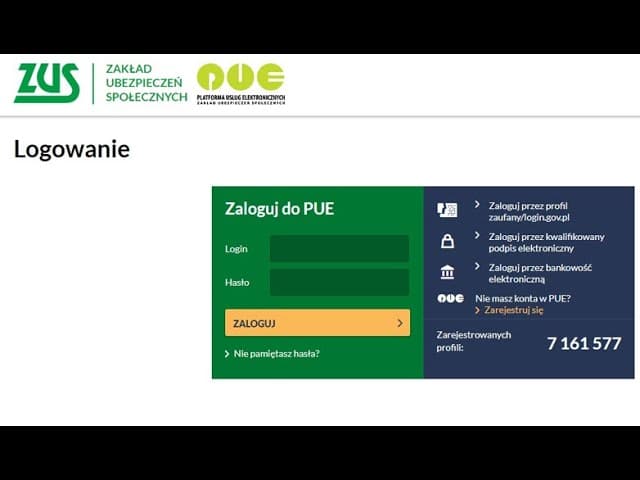
Every insured person in Poland has access to the Electronic Services Platform (PUE ZUS), soon to be modernized into eZUS. This online portal allows foreigners to:
- Check if the employer is paying contributions correctly.
- Calculate projected pension amounts.
- Apply for benefits (e.g., child benefits like 800+) electronically.
Access requires a "Trusted Profile" (Profil Zaufany) or electronic banking credentials.